

Appendix A · Three-stage bootstrap
This appendix tells how the kaikai compiler is built from nothing but a plain C compiler. It’s not part of the language the reader needs to know to program; it’s part of the project’s story, an engineering decision with lasting consequences.
If you find yourself asking “why does it matter how the
compiler is compiled?”, the short answer: because it
defines whom you trust and why. A language whose compiler
is built from a plain cc and nothing else is a language
anyone can audit, reproduce, and maintain. That’s technical
freedom few modern languages offer.
A.1 The bootstrap problem
A compiler is a program. Like any program, it has to be compiled to run. New compilers run into an immediate paradox: what compiles the compiler the first time?
Three historical answers:
- Write it in C (or assembly) the first time. The classical route. GCC, MRI Ruby, CPython, V8 were born this way. The cost: the new compiler carries C’s surface forever, or gets rewritten in itself later through a costly migration.
- Write it in an existing language that already has a compiler. That’s what Rust did with OCaml initially, what Swift did with C++. It inherits the host language’s dependencies: compiling Rust required installing OCaml, until Rust was rewritten in itself.
- Incremental self-hosting. Start with a small compiler (for a subset of the language), written in something portable, use it to compile a bigger compiler (written in the language), and so on. That’s what kaikai does with its three stages.
A.2 Stage 0: the compiler in C
stage0 is a compiler written in standard C. Its only
dependency is any C compiler:
$ cc stage0/*.c -o kaic0No frameworks, no generators, no exotic libraries. Plain C.
The file stage0/runtime.h is the runtime for compiled
programs: reference counters, list and string primitives,
panic. All of that fits in a few thousand lines.
What does kaic0 compile? kaikai-minimal, a deliberate
subset of the language. The grammar and constructs in
kaikai-minimal are documented in docs/kaikai-minimal.md.
What’s not in kaikai-minimal: algebraic effects, fibers,
protocols, contracts, units of measure. The minimum to
write a compiler.
Stage 0 is built to be auditable. A programmer who wants to understand what’s going on can read the C source line by line: lexer, recursive-descent parser, simple type checker, C emitter. Five files.
A.3 Stage 1: the compiler in kaikai-minimal
Once kaic0 works, we write a new compiler in
kaikai-minimal. This compiler, stage1, does something
kaic0 can’t: it compiles the full language. Effects,
fibers, protocols, contracts, all of it.
$ kaic0 stage1/main.kai -o kaic1kaic0 compiles stage1 to produce an executable kaic1.
From here on, the C compiler is out of the picture: kaic1
is enough to process programs that use everything kaikai
offers.
It’s the first “self-validation”: the compiler written in kaikai-minimal proves that kaikai-minimal is expressive enough to implement a full compiler. If it weren’t, this step wouldn’t terminate.
A.4 Stage 2: full kaikai, self-hosted
stage2 is the definitive version. Written in full
kaikai (not the minimal subset), using effects, fibers,
and everything the language offers. End-to-end idiomatic
kaikai code.
$ kaic1 stage2/main.kai -o kaic2kaic1 compiles stage2, producing kaic2. This is the
compiler that gets distributed. The user installing kaikai
gets kaic2, not kaic0 or kaic1.
The three stages, end to end:
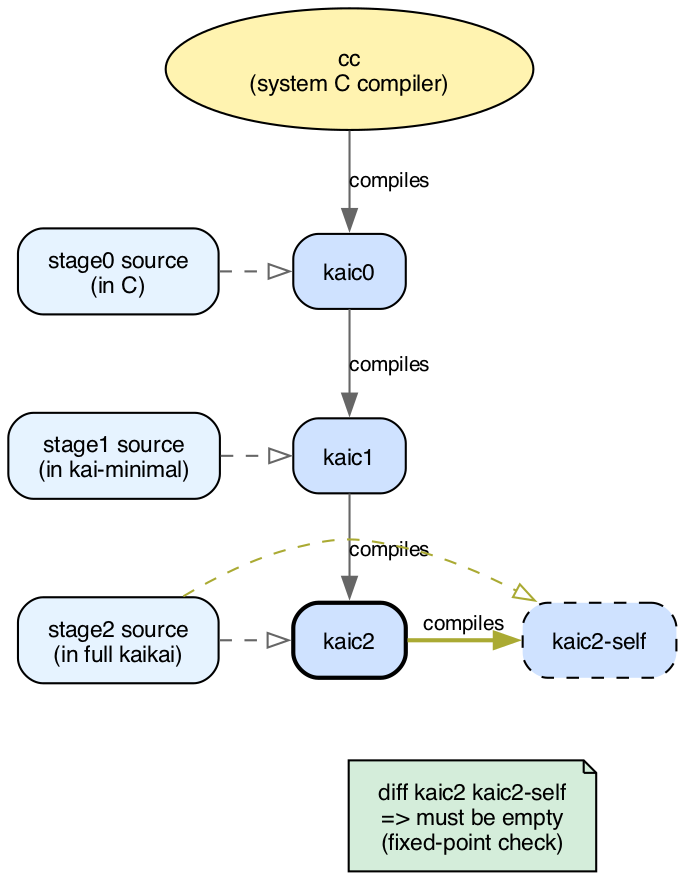
Figure A.1 · The three-stage bootstrap. Solid arrows show
which compiler produces which binary; the dashed arrows
point from each stage’s source to the binary it becomes.
Only cc is external; once kaic0 exists, the chain is
self-contained. The bottom row’s fixed-point check
(kaic2 compiling itself) is what §A.5 covers.
A.5 The fixed point: bootstrap validation
There’s a critical check at the end of the process:
$ kaic2 stage2/main.kai -o kaic2-self
$ diff kaic2 kaic2-self
They must be bit-for-bit identical. This means kaic2
compiled by kaic1 produces exactly the same thing as
kaic2 compiled by itself. In other words: kaic2 is a
fixed point of the compilation process.
Why does this matter? Two reasons:
- Detection of subtle compiler bugs. If two compiler
versions (
kaic1andkaic2) produce different binaries from the same source, one of them has a bug. The fixed point confirms the whole chain converges to the same answer. - Resistance to the Thompson attack. Ken Thompson published in 1984 a famous essay (“Reflections on Trusting Trust”) showing that a malicious compiler can insert invisible backdoors that survive recompilation. The classical defense is diverse double-compiling: compile with two distinct chains and compare. The fixed point is the modern version of that idea: if the whole chain converges to one binary, and that binary is reproducible from auditable sources, trust is justified.
A.6 Reproducible from a cc
The practical consequence of the three-stage bootstrap is
this: with just a C compiler, you can rebuild kaikai
entirely from source. No need to have kaikai previously
installed. No need to trust a binary downloaded from a web
page. No curl | bash.
$ git clone https://github.com/kaikailang-org/kaikai
$ cd kaikai
$ make
Underneath, make runs the three steps: stage 0 with cc,
stage 1 with stage 0, stage 2 with stage 1. It ends with a
kaic2 in the bin/ directory, and the fixed-point
verification ensures it’s the right one.
This is technical freedom few modern languages give you. Rust requires a previous Rust (downloaded as a blob). Go requires a previous Go. Swift requires a previous Swift. kaikai doesn’t: your C compiler is the entry point.
A.7 Costs and trade-offs
The three-stage bootstrap has costs. Worth listing because every engineering decision has them:
- Stage 0 has to be maintained whenever kaikai-minimal changes. If a new language feature falls within the minimal subset, stage 0 has to learn it. That means new C code, written by hand.
- It’s expensive to add dependencies to the compiler. Stage 2 might benefit from an external library (a parser combinator, an exotic data structure). But that library would have to be available in stage 1, which only understands kaikai-minimal. The pressure is toward keeping stage 2 self-contained.
- Building everything from scratch takes time. Not
much (the three steps together take less than a minute
on a reasonable machine), but more than a single
cargo build. For continuous CI, that matters.
Is it worth it? The project’s answer is yes, and the reason is philosophical: the compiler is the most trusted piece of software in the ecosystem. If the chain of trust can be audited end-to-end from plain C, then the rest follows.
A.8 Going further
The design decisions live in docs/design.md at
github.com/kaikailang-org/kaikai. The physical files are under
stage0/, stage1/, stage2/ of the repository. Ken
Thompson’s essay Reflections on Trusting Trust (CACM
1984) is worth reading if you care about the philosophical
justification for this approach.