

Chapter 13 · Concurrency and memory
Concurrency is where most languages accumulate debt. Threads
with shared memory lead to races that show up once a month
and get fixed three times before they actually go away;
async/await introduces function colors; actors fix the
previous problems but
historically come with a GC and a heavy runtime.
I fought with all three in their day, and kaikai’s bet came out of that fight. It is an unusual combination: **cooperative fibers
- per-fiber memory + Perceus**. The structure has three consequences worth naming before the syntax:
- No shared memory between fibers. Each fiber has its own heap. What one passes to another is copied or moved, so data races can’t arise by construction.
- No GC, no borrow checker. Perceus frees memory when
the last use of each value ends, without an asynchronous
collector and without asking the programmer to annotate
lifetimes. The compiler figures out where to put the
frees by analyzing the program. - Concurrency is an effect.
spawnis an operation of aSpawneffect, not a keyword. Creating and awaiting fibers composes with the rest of the system (State,Cancel, aFailyou declare yourself) using the chapter-12 machinery.
Let’s take it piece by piece.
13.1 The model: isolated fibers
A fiber is a unit of execution similar to a thread, but much lighter: on the order of hundreds of bytes instead of megabytes. A kaikai application can have thousands or hundreds of thousands of live fibers without breaking a sweat.
Fibers are cooperative. Each one runs until it hits a yield point: a call that voluntarily hands control back to the scheduler. Yield points are explicit:
spawn.yield(): “I’ve run for a while, try another”.spawn.await(f): “wait until fiberffinishes”.- IO operations that the scheduler intercepts (network reads, sleep, etc.).
Without yields, a fiber runs to completion. That’s local determinism: inside a block without yields, you know exactly what’s happening. Compared to preemptive threads, it takes away a whole class of bugs: there’s no race over data you touch between two yields because nobody can interrupt you.
The trade-off is that a fiber that never yields blocks every other one. It’s the programmer’s responsibility to add yields where they make sense. In practice, IO calls already include them, and the only case where you have to think about manual yields is a tight CPU-heavy loop.
Per-fiber memory
Each fiber has its own heap. When a fiber creates a record, a list, a closure, the space comes from that heap. Another fiber can’t touch it: can’t read it, can’t write it. The type system guarantees this.
How do two fibers communicate, then? By passing values. When
a fiber sends a message to another (via an actor mailbox or
the result of an await), the value is copied to the
receiver’s heap. For small types that’s trivial; for big
structures, kaikai uses Perceus to move instead of copy when
the sender no longer uses the value.
The guarantee that matters: there’s no way for two fibers
to hold a pointer to the same object. Data races, memory
visibility problems, cache coherence bugs — everything that
in traditional threads needs Atomic reads/writes or locks
simply doesn’t exist here. Concurrency is by message, not
by shared memory.
13.2 Perceus in one page
How is memory freed? Without GC and without a borrow checker, there’s a third approach: strict reference counting driven by Perceus (Lorenz, Leijen, Reinking, 2021).
The idea is that the compiler analyzes each function to find the exact point where each value is last used. At that point, it inserts an instruction that decrements the value’s reference count: if it hits zero, the value is freed; if not, it stays for another use.
fn example(xs: [Int]) : Int {
  let n = list.length(xs)   # first use of xs
  let s = list.sum(xs)       # last use of xs: consumed here
  s + n                      # xs no longer exists; n and s do
}
Compared to a GC:
- No pause. Freeing is synchronous, predictable, part of the generated code.
- No asynchronous overhead. The compiler knows the exact lifetime of each value.
- No separate thread. The scheduler doesn’t compete with a collector.
Compared to a borrow checker:
- No lifetime annotations. No
'a, no&, nomut. - No restrictions on use patterns. If you need two references to the same value, the compiler inserts the necessary increments and decrements.
The cost? When a value is used many times, counters move. For heavily shared values that adds overhead, and Perceus includes aggressive optimizations to minimize it (reuse in place: if a value is about to be freed and a value of the same shape is needed immediately after, the same memory is reused without touching the counter). In practice the cost is low and predictable.
For the extreme case — a computation that builds mountains
of throwaway structure only to fold it down to a scalar —
there is an opt-in escape: the region block, which
allocates in an arena and frees it wholesale, no counters
involved. It belongs to the same kind catalog as chapter
10’s units, and we cover it in chapter 19.
Why this matters for concurrency: Perceus works per fiber. Each fiber has its own counters, its own frees. There’s no synchronization between fibers for any counter: no two fibers ever share pointers to a value with a shared count. That’s why the “isolated fibers” model fits so cleanly with Perceus: the same invariant that rules out data races also keeps the reference counting lock-free.
13.3 Creating and awaiting fibers: the basic operations
The simplest way to use fibers is with spawn.spawn and
spawn.await:
import spawn

fn worker(tag: String, n: Int) : Unit / Stdout + Spawn {
  if n > 0 {
    println(tag)
    spawn.yield()
    worker(tag, n - 1)
  }
}

fn main() {
  let f = spawn.spawn(() => worker("B", 3))
  worker("A", 3)
  spawn.await(f)
}
One possible output:
$ kai run examples/ch13/01_two_fibers.kai
A
B
A
B
A
B
“One possible output” is literal, and worth stopping on.
This program promises no such order. A and B are
independent fibers: nothing in the code says the first A
comes before the first B. The runtime spreads fibers across
as many OS threads as your machine has cores, so in practice
you’ll see different orders run to run — A A A B B B is as
valid as the interleaving above.
If you want the perfectly alternating output, there’s a way:
$ KAI_THREADS=1 kai run examples/ch13/01_two_fibers.kai
A
B
A
B
A
B
KAI_THREADS=1 pins the scheduler to a single thread, and
there spawn.yield() is the only thing deciding whose turn it
is. That’s the mode you’ll want for reading this chapter’s
examples whenever the point is to see the alternation. More
on this in §13.8; for now, hold on to the idea that the
alternation is a property of the single-threaded scheduler,
not a guarantee of the language.
Reading literally:
import spawnbrings in the fiber operations.spawn.spawn(() => worker("B", 3))creates a new fiber that will run the lambda when the scheduler picks it.worker("A", 3)runs in the current fiber (main’s).spawn.yield()insideworkerhands control back: the fiber declares a point where it may lose its turn.spawn.await(f)waits forfto finish beforemainreturns.
Spawn appears in worker’s signature because the function
calls spawn.yield(), which is a Spawn operation. The row
propagates upward like any other effect from chapter 12.
Why yields are explicit
In languages with preemptive threads (Java, Go, Rust with
std::thread), the scheduler can interrupt a thread at any
instruction. That forces you to program as if any line
could be interrupted by another fiber modifying shared
data.
In kaikai, a fiber keeps running until it hits a yield point. Between yields, you have local determinism: if you modify a local value, nobody else will touch it until you give up control. This drops a lot of cognitive load.
In exchange, you have to remember to yield. The mental
rule: if your function has a long pure-CPU loop, add a
spawn.yield() every so many iterations. IO functions
already yield internally.
13.4 Nurseries: structured concurrency
spawn.spawn + spawn.await works, but it has a problem:
if you forget the await, the fiber outlives the scope that
created it. And if that fiber fails, you find out late or
not at all.
Nurseries tie fibers to a lexical scope. A fiber can only live inside a nursery, and the nursery waits for all its children before exiting.
import spawn

fn worker(tag: String, n: Int) : Unit / Stdout + Spawn {
  if n > 0 {
    println(tag)
    spawn.yield()
    worker(tag, n - 1)
  }
}

fn main() : Unit / Stdout + Spawn + Cancel {
  let _ = nursery { n ->
    n.spawn(() => worker("A", 3))
    n.spawn(() => worker("B", 3))
  }
}
The let _ wraps the whole nursery: the block returns the
value of its last expression (here a Fiber[Unit] we don’t
want), and let _ discards it. It is not what makes the fibers
get waited on; the nursery does that on its own. It just throws
away a value we don’t use.
nursery { n -> ... } opens a scope. Inside, n is the
capability to create fibers:
n.spawn(f)creates a child fiber. Returns aFiber[T]whereTis whatfreturns. Here we don’t even bind it: we don’t need the value, and the nursery waits for the fibers anyway.n.await(f)waits for that fiber and returns its value. You only need it when you want the result; to just wait, you don’t.n.select([a, b, ...])waits for any one to finish and cancels the others.n.cancel(f)cancels a specific fiber.n.cancel_all()cancels all children.
What the nursery guarantees:
- By block exit, all children have finished. The nursery
joins every child automatically at the closing brace, with
no
awaitrequired. No leaks: a fiber doesn’t outlive thenurserythat created it. - If a child fails on its own, the others are canceled.
When a child raises
Cancelwithout anyone requesting it (a crash), the nursery cancels the siblings still alive and re-raises the cause out of the scope. A child you cancel on purpose withn.cancel, by contrast, finishes as an expected outcome and does not spread to the others. - If the nursery is canceled from outside, the cancellation propagates to all children.
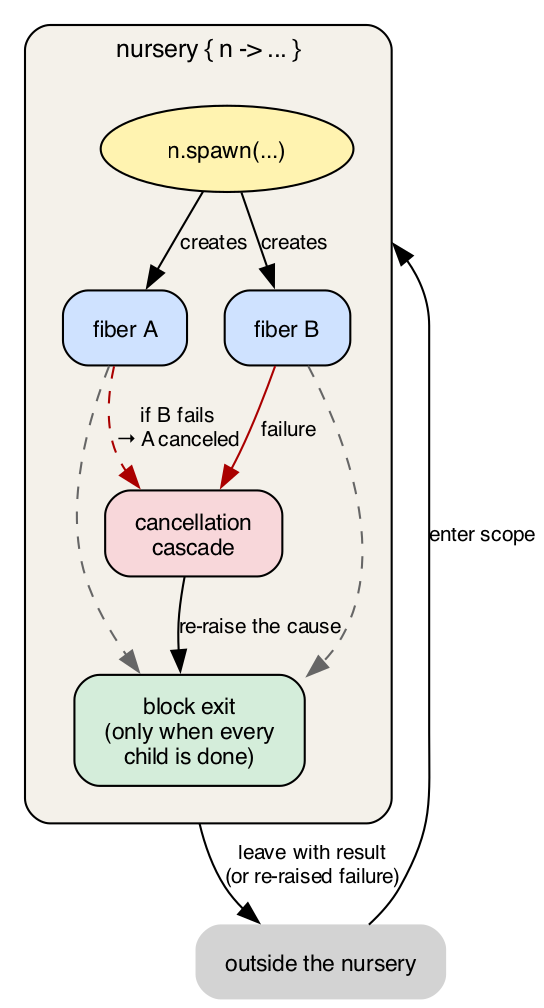
Figure 13.1 · Structured concurrency in one picture. The nursery is a lexical scope; child fibers live inside; nothing escapes. If one child fails, the nursery cancels the rest before re-raising; if the parent is canceled from outside, the cascade flows down.
This is called structured concurrency. The idea is
Nathaniel Smith’s, in his essay “Notes on structured
concurrency, or: Go statement considered harmful” (2018),
and appears also in Trio, Kotlin coroutines, Swift, and
OCaml 5 Eio. kaikai’s version integrates the pattern into
the effect system: the Spawn capability is only available
inside a nursery, and that’s what the type system enforces.
Why Cancel appears in main’s signature
Notice that main declares / Stdout + Spawn + Cancel.
Why Cancel? Because each spawn, await, and select is
a yield point, and every yield point can receive a
Cancel.raise() from the scheduler (if someone cancels the
nursery from outside, or if a sibling fiber fails). Every
function using Spawn implicitly carries Cancel.
nursery is sugar over handle
nursery { n -> ... } looks like a language keyword but
it isn’t. Fibers are an effect called Spawn, declared
in the stdlib:
effect Spawn {
  spawn[T, e](f: () -> T / e) : Fiber[T]
  await[T](f: Fiber[T])       : T
  select[T](fs: [Fiber[T]])   : T
  yield()                     : Unit
  cancel[T](f: Fiber[T])      : Unit
}
It’s an ordinary effect, declared the same way Log or
State[T] were in chapter 12. And nursery { n -> body }
is rewritten at compile time to handle { body } with Spawn as n { ... }, with an internal handler that manages the
child tree, waits for pending children on exit, and
propagates failures.
That means the language core has no concurrency
primitives: it has effects. Fibers, nurseries, and
cancellation are a library built on two stdlib effects
(Spawn and Cancel). Chapter 14 will do the same for
actors (effect Actor[Msg]), and the pattern repeats:
what’s distinctive about kaikai isn’t the list of
constructs but that all of them are the same construct —
algebraic effects — under different names.
13.5 Cooperative cancellation
Cancellation in kaikai is cooperative: the scheduler
doesn’t kill a fiber outright. It delivers a Cancel.raise()
at the next yield point. The fiber can:
- Unwind cleanly. If it doesn’t handle
Cancel, the unwinding pulls it out of anyhandle,nursery, etc., and the cancellation handlers above take control. - Handle
Cancelto clean up. The fiber installs aCancelhandler that runs the cleanup (close files, release connections) and does NOT callresume, letting the unwinding continue.
fn long_worker(tag: String) : Unit / Stdout + Spawn + Cancel {
  handle {
    count(tag, 0)
  } with Cancel {
    raise(resume) -> {
      println("#{tag}: canceled, doing cleanup")
      # not calling resume: the fiber unwinds
    }
  }
}

fn count(tag: String, n: Int) : Unit / Stdout + Spawn + Cancel {
  println("#{tag}: #{n}")
  spawn.yield()
  count(tag, n + 1)
}
long_worker counts indefinitely. If the nursery cancels
it, the Cancel handler prints its message and the fiber
exits. It doesn’t hang, it doesn’t kill the process.
The conceptual key: Cancel.raise() is the operation,
and handle ... with Cancel { ... } is the handler. Same
pattern as chapter 12: cancellation is another effect, with a
handler written by the user or installed by the runtime.
Spawn.cancel(f) and user-installed Cancel handlers
Two related names worth pinning apart:
- The
Canceleffect is what a fiber receives when cancellation reaches it. Its single opraise()is injected by the scheduler at the next yield point. Spawn.cancel(f)is what a fiber calls to ask the scheduler to deliverCancel.raise()to fiberf.
When you n.spawn(...) with a nursery cap n and get back a
child fiber, Spawn.cancel(child) does not kill it: it
schedules the delivery. The child, on its next yield, receives
Cancel.raise() and its own Cancel handler runs — exactly
the one the child installed with with Cancel { ... }. If it
installed none, the fiber unwinds cleanly and any handlers
further up the stack (typically the nursery’s) take over.
The one exception is trap-exit in the actor model (ch. 14): a fiber can mark itself so that peer crashes turn into mailbox messages instead of triggering cancellation, but that’s an explicit local opt-in — the default remains the cooperative cancellation described here.
13.6 Per-fiber mutable memory
Chapter 12 §12.7 covered var (local cells, sugar over
State[T]) and the Mutable effect (which rules Ref[T]
and Array[T] when the mutation is observable). All that
machinery works the same in sequential code, with one
addition that comes from the fiber model: mutable memory
lives in the heap of the fiber that created it.
When a fiber creates an Array[T] or a Ref[T], the space
comes from its own heap. Another fiber has no way to reach
that memory: no shared pointers, no reference passing
between fibers. If a fiber wants to give a mutable value to
another, it sends it through a mailbox (chapter 14) and the
runtime moves the contents to the receiver’s heap.
This is the piece that ensures mutation doesn’t introduce
data races in kaikai. In a language with threads and shared
memory, a mutable Array[T] needs locks or atomics to be
touched from several threads. In kaikai, the type system
guarantees that no Array[T] is being modified by two
fibers at the same time, because no Array[T] is reachable
from two fibers at the same time. The memory isolation of
§13.1 covers mutable cells too.
13.7 Why fibers can’t escape their nursery
A detail of the type system: Fiber[T] is not a movable
value. You can’t return it from a function, can’t store
it in an Option or a record, can’t pass it to another
fiber.
fn doesnt_compile() : Fiber[Int] {       # ERROR
  nursery { n ->
    n.spawn(() => 42)                     # can't return
  }
}
Why? Because a fiber only makes sense inside the nursery that created it. If you could return it, who would await it? Who would cancel it if the nursery ends? The structure breaks.
A list of fibers inside the same nursery is legal:
nursery { n ->
  let fibers = [1, 2, 3] | (x) => n.spawn(() => process(x))
  fibers | (f) => n.await(f)
}
But that list lives inside the nursery. It can’t escape.
This closes the model: each fiber has a known parent, each fiber ends before its parent ends, and the type system guarantees it syntactically, not by convention. There’s no way for a fiber to be orphaned.
13.8 Case study: splitting work across fibers
We close with a pattern you’ll write many times: split a list of tasks across several worker fibers and collect the results at the end.
Before the code, a constraint worth having straight, because
it decides the shape of the solution: effect handlers are
fiber-local. Install a State handler in main, have a
child fiber run State.get(), and the program doesn’t even
compile:
error: effect not handled in spawned fiber: State
  --> main.kai:6:23
    |
  6 |       let f = n.spawn(() => State.get())
    |                       ^
  = note: a fiber does not inherit the parent's handlers
  = help: handle the effect inside the spawned body: `handle { ... } with State { ... }`
This isn’t a compiler oversight, it’s the same isolation
invariant that holds up the whole chapter. A capability is
part of a fiber’s context, and a fiber does not inherit the
context of whoever created it. What you hand across a spawn
is the values you capture in the lambda on the way in, and the
return value await collects on the way out. The capabilities
that do resolve inside a child come in two kinds, and neither
is yours: the ones the runtime supplies per fiber (Stdout,
Clock), and the ones that belong to the fiber by construction
(Cancel, Spawn, Actor).
The compiler stops it on the spawn line, which is where the
mistake is, rather than letting it blow up at runtime when the
fiber reaches the operation.
So the “shared queue” you’d write in Go with a channel, or in
Java with a BlockingQueue, isn’t written that way here. You
split the work up front and each fiber returns its own share:
import spawn
import core.list

fn process_batch(id: Int, batch: [String]) : [String] / Spawn =
  match batch {
    []           -> []
    [t, ...rest] -> {
      spawn.yield()
      ["worker #{id}: #{t}", ...process_batch(id, rest)]
    }
  }
process_batch doesn’t know other fibers exist. It takes its
batch, walks it, and builds the output list. The
spawn.yield() is there so the workers take turns; it doesn’t
change the result, it just makes the thing genuinely
concurrent.
main splits, waits, and concatenates:
fn main() : Unit / Stdout + Spawn + Cancel {
  let results = nursery { n ->
    let a = n.spawn(() => process_batch(1, ["alpha", "bravo"]))
    let b = n.spawn(() => process_batch(2, ["charlie", "delta"]))
    let c = n.spawn(() => process_batch(3, ["echo", "foxtrot"]))
    n.await(a) ++ n.await(b) ++ n.await(c)
  }
  print_all(results)
  println("(#{list.length(results)} tasks processed)")
}(print_all is a trivial walk over the list; it’s complete in
the example file.)
Output:
$ kai run examples/ch13/06_batch_split.kai
worker 1: alpha
worker 1: bravo
worker 2: charlie
worker 2: delta
worker 3: echo
worker 3: foxtrot
(6 tasks processed)
And this time the output is guaranteed, unlike the earlier
examples in the chapter. Not because the fibers run in order —
they run however they like, on whatever cores are around — but
because nobody prints from a fiber. The workers only return
lists; main concatenates them in the order it chose when it
wrote n.await(a) ++ n.await(b) ++ n.await(c), and only then
prints. The output order is a consequence of the code, not of
the scheduler.
That’s a design rule worth more than the example itself: if you care about order, impose it at the join point — don’t trust the order of execution.
And if the work can’t be split up front — if tasks arrive over time, or vary so much in length that you want whichever fiber frees up to take the next one? Then you need something that owns the queue and answers requests. That something is an actor, and that’s chapter 14.
Concurrency and parallelism
Two words worth keeping apart, because they get conflated constantly.
Concurrency is a property of your program: having several lines of work alive at once, progressing independently. Parallelism is a property of the machine: two of those lines executing instructions at the same instant, on different cores.
kaikai gives you both. Fibers are the concurrency mechanism: lightweight, cooperative, tied to a nursery. And the runtime spreads them by default across as many OS threads as the machine has cores, with an M:N scheduler that steals work between threads. Nothing to request, nothing to configure: the program you wrote back in §13.3 already uses your sixteen cores if you have them.
What does not change with the thread count is the semantics:
- Each fiber still has its own memory. A message crossing from one thread to another is copied, so Perceus reference counting still needs no atomics.
- Fibers are still cooperative: none is interrupted mid instruction. Between two yields, a fiber has local determinism.
- Nurseries, cancellation and
awaitbehave the same at one thread or at thirty-two.
What does change is what you already saw: the order in which
independent fibers interleave stops being predictable. On one
thread, spawn.yield() decided the turns and the output was
reproducible. On several, it isn’t. That’s why KAI_THREADS=1
still exists: it forces the single-threaded cooperative
scheduler, byte-identical to the old one. It’s the tool for
debugging a race, for a test that compares literal output, or
for reading a teaching example like the ones in this chapter.
$ ./program                  # as many threads as cores
$ KAI_THREADS=4 ./program    # four, no more, no less
$ KAI_THREADS=1 ./program    # cooperative, reproducible
Now the useful question: will it help you? If your program is IO-bound — waiting on the network, reading files, receiving messages — fibers already paid off before, because while one waits for bytes the others run. If it’s CPU-bound, fibers used to give you structure but no speed; today they give you speed too, as long as the work splits into pieces that don’t depend on each other. The example in this section is exactly that shape.
13.9 Philosophy: two invariants worth remembering
If you want to keep two things from this chapter, let it be these:
-
Each fiber has its own heap. No shared memory between fibers. Communication is by message (actor mailbox,
awaitresult). Data races don’t exist by construction, not by discipline. -
Each fiber has a life tied to a lexical scope. It can’t escape the
nurserythat created it; the type system rejects any attempt. If the parent ends, every child has ended. If a child fails, the siblings are canceled.
These two invariants support each other. Memory isolation is what lets Perceus run per fiber without synchronization. Lexical structure is what lets memory be freed predictably at scope exit. Any model that breaks one of the two breaks the other.
In return, you get whole classes of bugs you no longer have to think about:
- No
volatile, noAtomic, no memory ordering. - No
lock, nomutex, noRwLock. - No borrow checker, no
'alifetimes, noRc<RefCell<T>>. - No
async fn, noFuture, no function colors. - No GC pause-the-world.
It’s a trade-off: you give up the freedom to have arbitrary pointers between fibers. But the gain — in safety, in predictability, in mental simplicity — is what justifies the model.
Exercises
13.1. Modify the §13.3 example (two cooperative fibers)
so that worker("A") does 5 iterations and worker("B")
does 2. How does the output change? What happens if you
remove the spawn.yield()s from one worker only?
13.2. A fiber creates an Array[Int] locally and
modifies it with a[i] := v. Then it exits without passing
it to anyone. Why doesn’t this program introduce data races
even if another fiber is running concurrently? Answer in two
lines, in terms of the per-fiber memory model from §13.1.
13.3. Implement a function with_timeout[T](ms: Int, f: () -> T / Spawn) : Option[T] / Spawn + Cancel + Time. Use
n.select to run f against a fiber that does
Time.sleep(ms) and returns None. Hint: you’ll need a
local sum type to distinguish “completed” from “timeout”.
13.4. §13.8 splits the batches up front and evenly. Modify it so the batches are wildly uneven (one with ten tasks, two with one) and time the whole run. Then split the same eleven tasks into three even batches and time it again. Why does static splitting leave cores idle, and what would you need to avoid it?
13.5. A fiber that enters an infinite loop without
spawn.yield() never gives up its turn. Write that code and
observe what happens: first under KAI_THREADS=1, then
without the variable. Why does the symptom change? Then add
yields every N iterations. How often? How do you choose N?
13.6. In your usual language, find a concurrent program you wrote or maintain. Count how many lines are “real work” (the program’s logic) vs how many are “concurrency plumbing” (mutex, queues, atomics, async/await, callbacks). Estimate what percentage of the code would remain under kaikai’s model.